Monday, October 4

Photosafari Kenya (wildebeest migration)


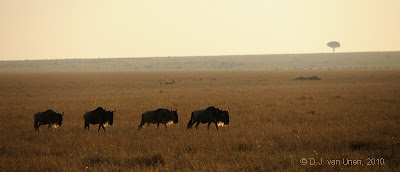
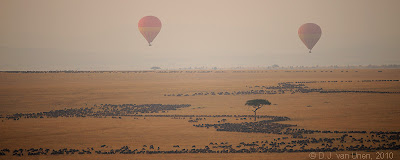
It's called one of the last large migrations on our planet. We are talking about the great wildebeest migration in Eastern Africa, the topic of today's post. Yearly, about 1,5 million wildebeest make their journey through the savannah plains of the Serengeti and Maasai Mara ecosystems. This unique pilgrimage already exists for God knows how long. Driven by their constant search for food and water, they follow a kind of oval route of about 3000 kilometers in a clockwise direction. They reach the plains of the Maasai Mara between August and October. Before my trip to Kenya, I had conceived how it would feel like to be in the middle of such a wildlife spectacle .... to be surrounded by such an enormous amount of animals. Well, it exceeded my wildest imaginations and triggered all my senses. It felt special to stop in the middle of a large herd at sunrise and just listen to their constant cow-like sound and the rustle of their grazing. It felt special to enjoy a healthy bush breakfast in the middle of an endless procession of walking wildebeest. An hour or so later, the view is still the same despite thousands of them have passed in the meantime. But it is not all that romantic. I've never experienced so closely the battle of animals between life and death and their struggle to survive. One of the most remarkable experiences of the whole trip were the massive river crossings with thousands of wildebeest. All of you will remember those images from the famous wildlife movies. In the next post I will post some of the crossing photos.
See you,
Dirk-Jan
Thursday, September 30

Photosafari Kenya (lions)

Dear all,

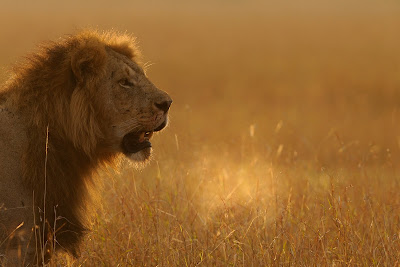
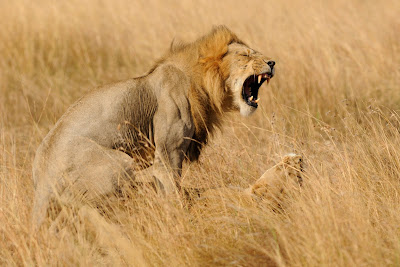
Thanks for your positive feedback on the previous post about the leopards of Maasai mara! This is motivating. As promised this post will deal with the king of the savannah, the lion. The lion population of Maasai mara is very dense. The reserve is about 30 by 50 km and is home to about 500 lions. There are several prides of which the so-called marsh pride is largest and consists of about 35 individuals. Because of the large population we had several lion sightings a day. In spite of their mighty appearance and expression, a lion sighting can be very boring. Actually, they are quite lazy creatures that spend most of the day resting in the shade. When a vehicle arrives with tourists they lift their eyes for a few seconds and quickly they return to the relax mode. But, whenever they become active ...... this is when the 'fun' starts ...........

There was the honeymoon couple that were mating almost every 15 minutes for a week. Every copulation ended with an agressive tête-à-tête between the partners, which is rather curious from a human perspective.

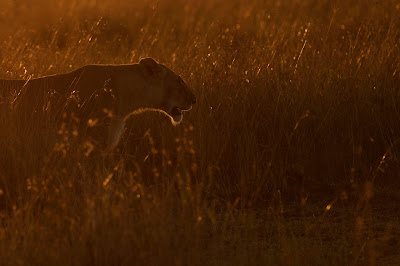
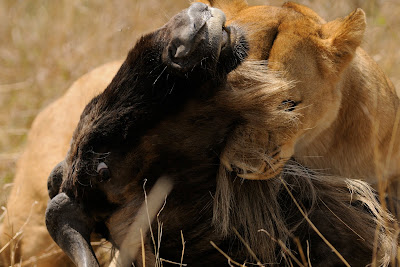
There was the female with a small cub. We found her while she had just started to hunt wildebeest that were migrating a few hundred meters further with thousands all together. First, she was slowly sneaking through the high savannah grass, perfectly using her magnificent camouflage. Followed by patient laying in ambush for an hour until the wildebeest were within her reach. A sudden run, panic in the herd, and there she was wrestling with an adult wildebeest that had no change to escape. A few minutes later the wildebeest migration just continued like nothing happened.


There was the small lion pride with a freshly killed wildebeest in the first morning light. It had been cold during the night and each breath of the lions condensed, a photographically very interesting situation. While there were about 5 vehicles present at the kill I still don't understand why we were the only ones taking shots from a backlit viewpoint. Later, we understood from our guide that the other guides had asked him in Swahili through the radio why he positioned his vehicle in such a strange position.


Hope to see you back for the next post on the wildebeest migration.

Dirk-Jan

Monday, September 27

Photosafari Kenya (leopards)


Dear all,

Just returned safely from an exciting photosafari to Kenya. It was a marvelous time and has surpassed all my wildest expectations. The Maasai mara plains were flooded by 100-thousands of wildebeest and zebras. They were everywhere! The predators and scavengers had the time of their lives and were feasting because of the abundant presence of food. Everyday brought new highlights and it felt like being in photographers' paradise. The organisation of our private photosafari was perfectly arranged by Sunworld safaris, our guide James Nganga was outstanding, and Mara Bush camp is a fantastic place in the heart of the wildlife reserve with excellent food, beautiful safari tents, and a fantastic staff. I realise that this text is full of superlatives, but to be honest, it's true.


But now ........ returned home with about 3000 photos and it will not be easy to select them. Next month, I would like to share with you a photographic coverage on the highlights in 10 chapters. Today we start with part I: leopards.


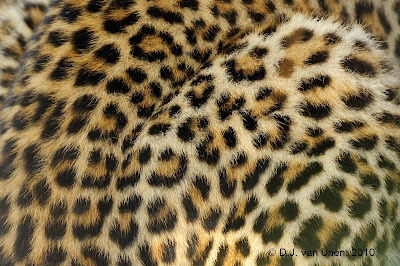
These elusive predators prefer riverine biotopes. Despite their beautiful patterned fur, they are not easy to spot as they spend most of their time in dense shrub areas and trees. In the direct vicinity of Mara Bush Camp a female leopard has its territory with her two one-and-a-half-year old cubs. We had four leopard sightings in 9 days and the last occassion gave the best photographic results as it happened in early morning light, there were not too many vehicles around, and the cat showed us some typical behaviour. Can one imagine a better start of the day?


Next post will be on another big cat, the king of the savannah.


Best regards,
Dirk-Jan

Tuesday, August 31

Kenya


Dear all,

We are getting in the excited state! Next weekend my father and I will leave for a photo safari to Kenya. Our two-weeks holiday will lead us to the world-famous Maasai Mara plains and Lake Nakura. At the moment the wildebeest migration is in full swing and there are about 1.4 million wildebeest and 200,000 zebra and gazelle grazing on the Maasai Mara plains. Party time for the lions, cheetahs, leopards, and crocodiles! We are looking forward to observe this spectacular event, one of the last big migrations on our planet. During our visit we will stay in the Mara Bush Camp (see video). In about two weeks I will start posting the photos and perhaps a small video as my father is taking a video camera with him. I would like to recommend the wonderful photos of Jan van der Greef as an appetizer. Please enjoy his themes 'Feline energies' and 'Cycle of Life'.

See you later!

Dirk-Jan

Saturday, August 28

Dynamic Texel (II)


Dear all,

The last post was on the dynamic sand dunes of de Hors on Texel. The term 'dynamic' also applies to some other areas on the island, for instance the Slufter. This reserve on the North sea coast of Texel is enclosed by high dunes and has one open connection with sea via a broad gully. The tide comes in twice a day and with storm the entire plain turns into a lagoon. The result is a dynamic area, which is rich in salt-liking vegetation and animals. Every season has interesting motives and in summer its plains are covered with flowering limonium and sea wormwood. A photographic feast! On one occassion, during a sunset walk, the sky went through some very colourful transitions. I had to react fast because these conditions only lasted for 30 minutes. Luckely, I had already selected some places to put the tripod during another walk. Preparation paid out.
Have a nice weekend,
Dirk-Jan

Tuesday, August 17

Dynamic Texel (I)

Dear all,

It's quite some time ago since my last post. You might have thought: "No new photos?, No news?" Well, it was my summer recess. Time for our family holiday, relaxing, archiving the photos of last spring, and making plans for coming fall (a photo safari to Kenya is on the horizon!). July and August aren't my favorite months for photography in the Netherlands, as wildlife activity is not too abundant. Nevertheless, during our recent family holiday on Texel there were some interesting photographic motives. One of them were the dynamic sand dunes of 'de Hors'. If you want to observe the formation of dunes? De Hors is the place to be. The landscape in this area is constantly changing due to the influence of wind, water, and pioneer vegetation. An interesting area with lots of photographic motives: from abstract sand patterns, nature recreation, to vegetation and landscapes. Some examples are posted in today's post. Next week we go to another dynamic area on Texel, known as 'de Slufter'.

Best regards,
Dirk-Jan


Sunday, June 20

Eurasian stonechat (female)


A female Eurasian stonechat is a nice sighting as well, despite her more pale plumage compared to her male. Male and female are often searching for food together. Their first breed was successfull. Perhaps, they are caring for their second breed? Let's wait and see!
Dirk-Jan